
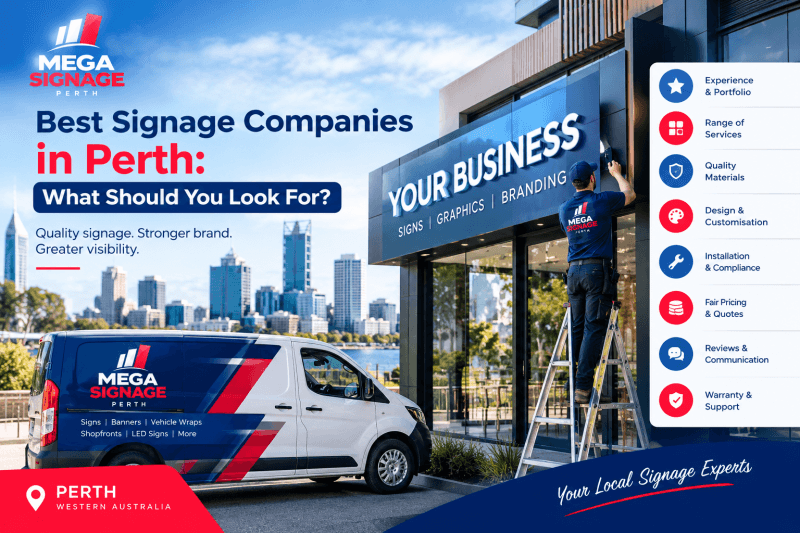
Choosing the right signage company can make a real difference to how customers see your business. Whether you own a retail shop, restaurant, office, construction company or mobile service business, effective signage helps people recognise your brand, find your location and understand what you offer.
However, finding the right provider is not simply about choosing the cheapest quote. You need a company that understands your requirements, recommends suitable materials, delivers professional design and provides clear information about production, installation and costs.
If you are searching for Signage Perth, this guide explains what to look for when comparing signage companies, which questions to ask before placing an order and how to choose signage that suits your business.
Why Choosing the Right Signage Company Matters
Business signage is often one of the first things potential customers notice about a company. A faded shopfront sign, difficult-to-read lettering or poorly installed graphics can create the wrong impression. Well-designed signage, on the other hand, helps your business look professional and makes your brand easier to recognise.
A reliable signage provider should understand both the visual and practical sides of your project. This includes selecting suitable materials, preparing artwork, considering where the sign will be installed and explaining any additional requirements.
For businesses across Perth, these decisions are particularly important for outdoor signage exposed to sunlight, rain and wind.
The right signage partner can help you make informed decisions instead of spending money on a sign that does not meet your expectations.
1. Check the Company’s Experience and Previous Work
One of the first things to consider when comparing signage companies in Perth is their experience with projects similar to yours.
A provider may produce excellent banners but have limited experience with illuminated building signs or complex shopfront installations. Before making a decision, review examples of completed projects and check whether the company offers the type of signage you need.
Look for examples such as:
- Shopfront and building signage
- LED signs and illuminated lettering
- Vehicle wraps and business car stickers
- Window decals and promotional graphics
- Acrylic and metal signs
- Corflute signs and A-frame displays
- Banners and event signage
- Safety and workplace signs
Pay attention to the quality of the printing, clarity of the lettering, consistency of branding and overall finish.
If possible, ask for examples from businesses with similar requirements. This gives you a better idea of whether the company can deliver the result you have in mind.
2. Compare the Range of Signage Services
Different businesses require different types of signs. A local café may need a shopfront sign, window graphics and an outdoor A-frame, while a trades business might benefit more from vehicle signage and branded work vehicles.
Choosing a company with a suitable range of services can make it easier to keep your branding consistent across different locations and materials.
Here are some common options to consider when looking for Signage Perth services.
Shopfront and Building Signs
Shopfront signs help customers identify your business from the street. Building signage can include fascia signs, external lettering, reception signs and larger identification displays.
The right option depends on the building, available space, viewing distance and your brand’s appearance.
LED and Illuminated Signs
Illuminated signage can help businesses remain visible after dark or in locations where additional lighting is useful. Options include LED lightboxes, illuminated lettering and other custom lighting solutions.
Ask about power requirements, installation, maintenance and the warranty covering electrical components.
Vehicle Wraps and Car Stickers
Vehicle signage allows businesses to display their branding while travelling between jobs or visiting customers. Depending on your budget, you might choose simple contact details, partial graphics or a full vehicle wrap.
Check the quality of the vinyl, the suitability of the material for your vehicle and the provider’s experience with installation.
Banners, Corflute and A-Frame Signs
These options are useful for promotions, events, construction sites, property advertising and temporary displays.
Consider how frequently the sign will be used, whether it needs to be portable and how well it will withstand outdoor conditions.
Safety Signs and Directional Signage
Workplaces, commercial buildings and industrial facilities may require signs that communicate hazards, instructions, restricted areas or directions.
For these projects, ask whether the provider understands the applicable requirements for your particular application. Do not assume that a decorative sign automatically meets workplace safety requirements.
3. Ask About Materials and Durability
The material used for your sign affects its appearance, lifespan, maintenance and overall cost.
For outdoor signage in Perth, it is important to consider sunlight, UV exposure, rain, wind and the specific conditions at the installation site.
Common materials include:
- Aluminium composite panels: Often used for business signs, fascia panels and external displays.
- Acrylic: Suitable for selected reception signs, lettering and modern display applications.
- Metal: Useful for durable signs and premium finishes, depending on the metal and protective coating.
- Corflute: A lightweight option for temporary advertising and promotional signs.
- Vinyl: Commonly used for vehicle graphics, window decals and printed signage.
- Banner materials: Suitable for promotional displays, events and selected outdoor applications.
A professional signage company should explain the advantages and limitations of the available materials rather than recommending the same product for every project.
Ask how the material performs in your intended location, what maintenance it requires and what warranty applies. A sign installed in a sheltered indoor space has different requirements from one exposed to strong sun and wind throughout the year.
4. Look for Professional Design and Customisation
A sign can be made from quality materials and still be ineffective if the design is difficult to understand.
Good signage communicates its main message quickly. Customers should be able to recognise your business name, understand the purpose of the sign and identify important information without unnecessary visual clutter.
When comparing signage providers, consider whether they can help with:
- Layout and visual hierarchy
- Brand colours and logo placement
- Font selection and readability
- Sign dimensions and positioning
- Material and finish recommendations
- Artwork preparation and proof approval
For example, a shopfront sign viewed from a busy road may need large lettering and a simple message. A reception sign can use smaller details because visitors usually view it from a shorter distance.
Ask to approve the final artwork before production begins. Confirm spelling, phone numbers, website addresses, colours and dimensions carefully.
This simple step can help prevent avoidable printing errors and costly rework.
5. Check Installation, Safety and Approval Requirements
Manufacturing is only one part of a signage project. Some signs need professional installation, particularly large building signs, elevated signs, illuminated displays and structures exposed to wind.
Before choosing a provider, clarify whether installation is included in the quotation or arranged separately.
For relevant projects, ask about:
- Site measurements and access
- Mounting methods and fixing systems
- Installation scheduling
- Electrical work for illuminated signs
- Site safety procedures
- Removal of existing signage
- Relevant council approvals and permits
Approval requirements can depend on the sign’s location, size, design and installation method. Certain signs within the City of Perth, for example, may require a sign permit or other approval before installation.
If your business is located in another Perth metropolitan council area, check that council’s requirements as well. Ask the signage provider who will handle any necessary applications and whether approval costs are included in the quote.
6. Compare Quotes Carefully, Not Just Prices
Price is an important consideration, especially for small businesses working within a limited budget. However, the lowest quote is not always the most economical option over the life of the sign.
Two signage companies may quote different prices because they are offering different materials, finishes, production methods or installation services.
For a fair comparison, request an itemised quotation that explains what you will receive.
Check whether the price includes:
- Design and artwork preparation
- Materials and printing
- Custom fabrication
- Installation and mounting hardware
- Electrical work, where required
- Access equipment, if necessary
- Removal of old signage
- Applicable approval-related charges
- GST and other relevant costs
Also ask about additional charges that might arise if site conditions change or the artwork needs to be revised.
If one quote is significantly lower than the others, ask the company to explain the difference. It may offer a perfectly suitable option, but you should understand what is included before making your decision.
The aim is to find the best balance between quality, suitability, service and total cost.
7. Read Customer Reviews and Check Communication
Customer reviews can help you understand how a signage company handles enquiries, deadlines, installation and problems after delivery.
Look beyond the overall rating and read comments that relate to projects similar to yours. Reviews mentioning clear communication, accurate artwork, reliable scheduling and professional workmanship can be useful when comparing providers.
You should also assess the company’s communication during your initial enquiry.
Does the team listen to your requirements? Do they explain technical details in straightforward language? Are they willing to discuss alternatives that suit your budget?
A dependable provider should give you realistic information about pricing and turnaround times instead of making promises without understanding the job.
Ask for written confirmation of important details, including the approved design, production timeframe, installation arrangements and warranty terms.
8. Understand Warranties and After-Sales Support
Business signage is a long-term investment, particularly when it involves custom fabrication or illuminated components.
Before placing your order, ask what happens if the sign develops a fault, the installation needs attention or a material defect appears.
Check the warranty documentation for:
- Coverage period
- Materials and components included
- Workmanship and installation coverage
- Exclusions and maintenance conditions
- The process for reporting a problem
Warranty coverage varies between products and providers, so avoid assuming that every sign comes with the same protection.
You should also ask whether the company provides repairs, replacement components or maintenance services if your needs change later.
Clear after-sales arrangements can be particularly useful for businesses with multiple signs or several locations across Perth.
9. Choose a Company That Understands Your Business Goals
The best signage solution is not necessarily the largest, brightest or most expensive option. It is the one that helps you achieve your business objective.
Before requesting a quote, decide what you want the sign to accomplish.
For example:
- Improve street visibility: Consider suitable shopfront or building signage.
- Promote a special offer: Explore banners, A-frame signs or temporary displays.
- Build brand recognition: Consider coordinated signage across your premises and vehicles.
- Improve customer navigation: Look at directional and internal signs.
- Increase visibility after dark: Explore suitable illuminated options.
- Advertise while travelling: Consider vehicle decals or a custom wrap.
Explain your goals to the signage provider and ask which options fit your budget, premises and intended audience.
A thoughtful recommendation should consider the purpose of the sign rather than simply encouraging you to purchase more products.
Why Consider Mega Signage Perth?
At Mega Signage Perth, businesses can explore signage options suited to different branding, advertising and identification needs.
Whether you are planning new shopfront signage, promoting a product, branding a company vehicle or improving visibility at your premises, the starting point is understanding what you want your signage to achieve.
Mega Signage Perth offers a range of signage solutions, including safety signs, corflute signs, A-frame signs, banners, acrylic signs, metal signs, LED signs, vehicle graphics, window decals and building signage.
When planning your project, consider the location, intended use, material, design and installation requirements before selecting the final product.
You can explore the available services at Mega Signage Perth and enquire about a signage solution for your business.
Final Thoughts
Finding the right signage company in Perth takes more than comparing a few prices. You should assess the provider’s previous work, service range, material knowledge, design process, installation arrangements, customer feedback and warranty terms.
It is also worth checking whether the quotation covers the complete project and whether any relevant permits or approvals need to be arranged.
Before making your decision, compare at least two or three detailed quotes and ask questions whenever something is unclear.
For businesses looking for Signage Perth, taking the time to evaluate these factors can help you choose signage that reflects your brand, suits your premises and delivers practical value over time.
Frequently Asked Questions
1. How do I choose the best signage company in Perth?
Compare previous projects, services, material quality, design support, installation capabilities, customer reviews and written warranty terms. Request itemised quotes so you can compare the full scope of work rather than price alone.
2. What types of signage can Perth signage companies provide?
Depending on the provider, options may include shopfront signs, building signs, LED signage, acrylic signs, metal signs, banners, corflute signs, A-frame signs, window decals, vehicle wraps and safety signs.
3. How much does business signage cost in Perth?
The cost depends on the sign’s size, materials, design complexity, illumination, fabrication and installation requirements. Basic printed signs may cost a few hundred dollars, while larger custom or illuminated projects can cost several thousand dollars or more. Request a project-specific quote for an accurate estimate.
4. Do I need council approval for business signage in Perth?
Some signs require permits or other approvals, depending on their location, dimensions, design and installation. Check with the relevant local council before production or installation and confirm who will manage any required applications.
5. Why is material quality important when choosing signage?
Suitable materials help a sign maintain its appearance and function under its intended conditions. For outdoor signage, consider UV exposure, weather resistance, wind, installation methods and maintenance requirements. Ask the provider to explain the expected performance and applicable warranty of the recommended material.